
Visionaries

What sensibly-thinking (unskilled) laborer surrenders his ditch-digger shovel to chase after and secure an even lesser-paying job?

It seems a reasonable question.

When he spotted the simple flier announcing, “Plumber’s Helper Wanted”, Clyde wasted little time pondering its meaning. Shedding his less-than-promising vocation as dirt-shoveler along open trenches in the nearby neighborhood, he soon found himself loading and unloading lengths of galvanized pipe, odd-looking pipe-threading devices, and a sewage-clearing apparatus nicknamed “the snake”.

A companion question follows the earlier one. What kind of mindset would propel a poor young woman hailing from a dusty Oklahoma village to set out by bus and travel mile upon mile across several states to arrive at a “foreign” destination with scant understanding of what may lie ahead?

By the time the paths of Clyde Baxter and his bride-to-be Thelma Christine finally (after their months of separation) reconverged near a sprawling body of water called San Francisco Bay, they had each unwittingly entered the world of VIM.

Several decades were to crawl by before a Philosophy Professor – Dr. Dallas Willard of another Golden State setting (U.S.C.) – would introduce the VIM acronym.

Vision – Intention – Means

Clyde’s mind and heart had given birth to a vision. To one day marry his sweetheart, Thelma.

Clyde’s vision, however, called for significant risk and extraordinary courage. If his dream of gaining this pretty country girl as his life-long companion were to become reality, both he and Thelma must leave behind the dust-laden, increasingly barren, cotton fields of their beloved Sooner State.

It was a daring, costly venture the couple had struck out on, from the moment Clyde had leapt aboard his first freight train departing Oklahoma. And now, clarity of focus had – across the Greyhound miles – settled more deeply in his fiancé’s soul. There would be no going back. Thelma, too, owned the Vision.

©2025 Jerry Lout
Forward Motion

The young man from Schulter glanced to his right, then left. The sun had just set and in the half-light of dusk, he knew he dare not wait. He must leap aboard the slow-moving freight train at this exact moment or not at all.

Over the coming days in varied rail yards along his westward route, a similar scene replayed. At last, his final “hijacked” train ride landed him in Oakland. Clyde was poor, having fled his native Oklahoma where an awful drought – the notorious Dust Bowl – was underway. He had to find work. The Golden State (so he was told) offered the best promise.

Weeks passed.

In a matter of days, blisters from handling construction shovels had risen on his palms. He knew that ditch digging held little promise of a future for him and his bride-to-be. But the job put dollars into Clyde’s pocket, for now, some of his first since landing in Oakland.

He worked hard and soon the ambitious Okie answered a newspaper ad, “Plumber’s Helper”.

After a short stint on the job, Clyde advanced from ‘helper’ to ‘apprentice.’

“Plumber’s Apprentice. How about that.”

Growing up in the home of Clyde Baxter Lout, I caught wind of several names. These were his fellow journeyman plumbers. Kloon. Leggett. Mason, among others.

For my dad, choosing the route of apprenticeship bore fruit.

Apprenticing to Jesus Christ bears fruit as well. Enduring and gratifying fruit. Kingdom fruit.

The apprentice-to-Jesus has shifted gears in his life’s trajectory. He sets out to grow into the kind of person he believes he’s marked by heaven to become. He embraces something called spiritual formation. Not everyone calls it this. Some speak of sanctification – an ongoing work of grace. It is characterized by living forward into a different kind of life, life on God’s terms.

At such a juncture some seekers after ‘more’, offer up a clear “Yes, I’m in. I will be a disciple of Jesus.” For others, there is a warming process, like a courtship.  Regardless, a new kind of season has gotten underway. For many who have caught the astonishingly good taste of God’s pardoning love and have drunk deeply of it through faith, they need no further persuading. They are in for a lifetime! As a widely-sung campfire melody puts it, “No turning back, no turning back.”

©2022 Jerry Lout


Out of this World

By my eighteenth year I had never seen a televised funeral, much less for a president.

From my elevated perch at the client’s living room I watched my dad, pipe-wrench in hand, navigating space beneath the house. Stooped beyond an open place in the hardwood flooring, he called up occasionally, assigning me a task common to plumber wannabes.

Stepping carefully to avoid a fall through the rectangular gap where the floor furnace had earlier rested I took in the somber music and snatched glimpses of the T.V.’s black and white images. The casket, draped full-length in the national flag, held the body of John Fitzgerald Kennedy. It rested atop a carriage drawn by seven white horses. I shivered at the cold air rising from the opening below, the absentee furnace depriving us of warmth in the November chill.

Thirty months earlier as my Sophomore High School year was ending, this popular young president had boldly announced, “we choose to go to the moon!” He attached a timeline. By the end of this decade. That was May, 1961.
Challenging his citizens to beat the Soviets in a great skyward race, Kennedy’s speech had fueled a bigger-than-life dream. Pursue the unthinkable. That was then. An assassin’s bullet had afterward found him and eight years had now lapsed.

I dismounted my blue Vespa scooter before the newspaper plant that helped fund my college fees and support my young wife. San Antonio’s July heat bore down. Removing the bike helmet, I padded my brow and neck with a handkerchief, collecting enough moisture to quench a small fire. Relaxing a moment, I squinted across the way, marveling once more at the recently erected Tower of the Americas, landmark of the city’s historic International Exposition otherwise known as Hemisfair. Making my way to the shop floor I settled into my usual place before the teletype equipment. This, however, was no usual day.

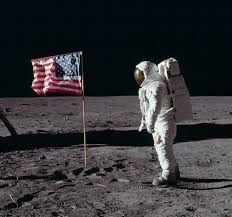
Minutes later I joined fellow technicians before a T.V. set. In near disbelief our gazes drank in something no humans in all history had witnessed and few had dared dream. Our past president, his body long since entombed in Arlington Cemetery, had declared it, “we choose to go to the moon”.

The television crackled as a man’s voice traversed a great expanse of outer space. It found its way to an upper floor of the San Antonio Express. The voice of Neil Armstrong.
“One small step for a man, one giant leap for mankind.”

All about me the newspaper’s work area rang with cheers. I fell silent and revisited memories of a different work place. North American Aviation. Where I had not that long ago, sorted, filed and fetched engineering blueprints.

Labeled Apollo.
©2017 Jerry Lout