Black Heart

“SO, this is the man with the black heart!”

It was my first time receiving such a greeting – from anyone – much less a distinguished organizational head.
Wednesday chapel ended, the guest speaker had found his way from the platform to the early row of students gathering up their textbooks.

Stepping before me he had seized my shoulders and studied my face for every bit of two seconds. Before I could respond to his “black heart” salutation Carlton Spencer took me in a bear hug. He thumped my back as though he’d run into an old friend from the past. A rich shock of silver-white hair complimented his mouthful of gleaming teeth. Carlton Spencer. Instantly I liked him, this Elim Missionary Assemblies president.

Black heart. . .

Ann and I had already agreed to seek out an Africa-focused agency. While IBC did champion missions, its out-of-country vision centered on Far East lands and on Mexico – an obvious short hop from this Alamo City. Indeed, a long weekend in our third year of college had found us and fellow students dust-laden and mesmerized – immersed in Spanish-language culture – the school’s traditional Easter outreach south of the border.

We had also found the Lord refining our focus within the African continent – stirring us much toward her eastern regions – Uganda and Kenya. Elim Missionary Assemblies had pioneered there, starting in the 1930s.

Welcomed by Rev. Spencer to visit Lima, New York as missionary candidates, we detected our stride toward Africa picking up pace. My Bible College commencement had come and gone and Ann was now a certified LPN.

With a letter from David Coote recommending us to a few pastors we hoped could get behind our vision, we set out. Painfully conscious of my inexperience in fund-raising, I was both sobered and assured. Our dependency must be in one supremely wiser than ourselves.

Seated in our freshly-loaded Pontiac, Ann and I faced each other. Excited. Nervous. Joining our hands we prayed. I slid the key into the ignition.

“Lord, here we go.”
©2017 Jerry Lout

Remember The Alamo (City)

A springtime San Antonio breeze caressed IBC’s Hallelujah Hill as I strolled about her dome. I would savor some memories these parting moments, taking in a view of which I never tired. A myriad twinkling city lights stretched to the southeast below. My reflective mood wakened images – faces, scenes – of our recent years, Ann’s and mine. We would soon move from this place. Distant Africa felt suddenly less distant.

What have I specially treasured along the way, about and atop this hill? Two highlights, among others, surfaced.

The Means to make it through. Yes, for sure, God’s provision, the means. . . Pumping gas at Bandera Road’s Philips station. . . Hauling Middle-schoolers by yellow bus to and from their own academic haunts. . . A long-retired, overly-generous Kentucky teacher. . . My bread-and-butter news-print employer, the San Antonio Express – towering opposite the Alamo. And praying friends believing in young people’s dreams.

I also prized the Instructors pointing the way. I smiled at the medley of talent and personalities.

• Mr. Irwin. Health-food-eccentric whose relentless compassion often drew him off campus, serving up coffee and (ironically) donuts to homesick entry-level soldiers and airmen from the numerous bases encircling the city. Men in uniform needed friends and Mr. Irwin readily introduced them to One ‘sticking closer than a brother.’
• Bob Lauver. The faculty’s youngest, our class sponsor.
• Ray Troyer. Wisdom of a sage whose penetrating eyes seemed to mine your soul.
• Bill Hamon. Energetic, high-volume Pentateuch instructor whose prophetic bent propelled him later to a bigger platform.
• David Coote, Japan-raised college president. His Life of Christ dramatizations coming with such grasp of material and energetic flair that student’s regularly laid aside their note-taking ball points to relish the scenes.
• Ruth Bell. Sister to David, who as a little girl entered Japan’s outdoor icy waters to get baptized. A children’s ministry power pack championing time and again a spiritual vision for the young.
• John Hagee, master orator. When preaching a chapel service his keenly-honed sermons and powerful deliveries seized heart and mind of every preacher-wannabe in earshot.

• And J. Andrew Freeborn. Calling his work ‘memorable’, comes close. But only close.
©2017 Jerry Lout

Recall

Of things I prized in my Bible college years, nothing matched the volume of raw text Mr. J. Andrew Freeborn had us ingest. Coaxing everyone to scripture memorization. Unforgettable.

The Romans course found every student rehearsing countless times Chapters Eight and Twelve. Their combined verses came to sixty. While for some sixty verses could seem a modest number, for youth whose minds ‘til now had snared only a handful of memorized passages, the challenge was daunting.

And when it came to the Ephesians course. It was another thing yet.

“Alright ladies and gentlemen”, Mr. Freeborn had raised his voice against the stirring of papers and shuffling of classroom furniture as we took our seats.

“Today we move into Ephesians, a letter Paul wrote from captivity, within a prison cell. It’s broken into six full chapters. I am here to make a pledge today, a promise to each and any of you taking this course.” Pausing, he scanned the room, waiting until all eyes turned his way.

“Memorize the book and here is my pledge. Commit to memory its body of text and you will be graded an ‘A’ for the entire course. You’ll gain your ‘A’”, he emphasized, “regardless how you perform on exams or how your assignments turn out.

“So I challenge you, I welcome you. Commit to memory all this book, reciting it to me at the end of this semester. You will have your perfect mark for the course.” He paused. “Agreed?”

Heads nodded.

Several students gave the challenge their best, myself among them. A hundred fifty-five verses numbering three thousand twenty-two words. Although a few came close, none of us hit our instructor’s mark. But the exercise carried its own reward. Mr. Freeborn knew it would – rich beyond our imaginations. Ephesians captivated us – endeared itself to us.

In the end several of us actually did earn an ‘A’. . . devoting to the enterprise many late nights. . . and gallons of black coffee.
©2017 Jerry Lout

Yankee-land

My eyebrows furrowed as we entered Pennsylvania and took in the expanse of her rolling hills, farmlands and forests. Puzzled, I wondered, Where are the sky-scrapers? Upstate New York was more bewildering.

Any Oklahoman knew that most Yankee states were blanketed throughout by asphalt and concrete. Our ever-expanding world as we motored northward from South Texas, alerted me repeatedly to my wonderful ignorance about the lay of the land. An ignorance of the kind New Yorkers employ when doubting whether Okies own automobiles.

I eased our car to a halt before an aged, multi-story brick structure perched atop a hill. The month was January and a frigid drizzle had begun descending in slow motion. Although it wasn’t yet 10 p.m. darkness had fallen several hours earlier. No one was in sight. I turned to my wife, now in the early months of her first pregnancy.
“Seems we’re here, darlin’. . . the sign out front says, Elim.”

Genesee Wesleyan Seminary, one of the first coed schools in the U.S., had opened its’ doors on this hill in 1831 and Elim’s training center now occupied some of those ornate structures from the past.

Our cold, dreary reception, climate-wise, was countered by friendly greetings of mission-agency staff next morning.
“Oklahoma? . . that’s where you’re from?” The office manager’s eyes brightened. “Then you’ll have to meet Ron and Jerry.” Noting our quizzical response, he went on. “Ron Childs is from Philly. He and his wife, Jerry are also here as missionary candidates. Jerry comes from down your way. Oklahoma.”

Another day passed before we formally met the couple who, as ourselves, felt destined for Africa. The first phrase passing through Jerry Childs’s lips betrayed her origins. This is no New Yorker, I thought to myself with a grin, registering the familiar drawl of my home state.

“Happy to meet you,” replied my wife. Then, drawn to the small bundle her new friend cradled in her arms, “What a sweet little one you have there. . . a girl?”

Jerry Childs smiled and nodded. “Thank you. Yes, a girl. Like to hold her?”

My wife drew near, her own mother-instincts already much alive.

She took up little Sarah and brought her close, little dreaming what lay ahead between the two in another time and place.
©2017 Jerry Lout

A Milestone

Taking a seat on a cushioned wicker chair, I stretch my legs forward, resting my feet on another. The coffee mug I hold signals a steamy aroma and I indulge a second sip.

A keen sense of satisfaction hangs in the early air as I settle into my restful spot at this temporary residence atop a gradual-sloped hill. The liquid blue of Lake Fort Gibson lies before me, a forested, hilly shoreline her furthest boundary.

Birds twitter their good-mornings and I take in the distant view from my elevated sanctuary.

Where did the years go?

Nineteen Sixty-Four had taken me from Oklahoma’s hills to Wyoming’s Rockies and on to Montana, land of extravagant surprise.

A breeze visited the deck where I sat. It seemed to carry a flavor. Of feeling, warmth, thankfulness.

By week’s end the Seventeen people dearest to our lives – Ann’s and mine – will have gathered here at the lake house, an hour out of Tulsa. Last night’s laughter – light-hearted banter of our earlier arrivals – offered promise of more. Lots more.

It’s an early celebration – five months early. The season’s climate along with travel logistics moved us to fudge the timing. Summer, not December. . . well-suited, too, for the overseas clan just arrived.

Children, their spouses, grandchildren – all converging. From Konawa, from Tulsa, from Congo.

Words of a greeting play at my thoughts, a phrase. Surreal. And sweeter than honey. We’re hearing it these days more and more, my bride and me.

I reach again for the coffee mug. The next swig tastes richer still as I let the phrase replay.

Happy Fiftieth, Grandma and Grandpa.”
©2017 Jerry Lout

Pluck

My plucky wife slipped the medical release document between unmarked leaves of her passport. Stamped Canandaigua, N.Y.,, her doctor’s letter had okayed this, her first-ever overseas flight. We would board for Africa May 26 – our first child (we didn’t know the gender) to be born in under two months.

***
“Where have you been?” The director’s voice carried an edge, the tone anything but casual.

A day earlier Ann and I had travelled the 5 ½ hours from upstate New York to Brooklyn. We would lodge at an inner-city Mission before passing through one of JFK Airport’s many international gates to then ascend into friendly blue skies.

The Mission sat in a more sullied neighborhood where pedestrian traffic sadly displayed prominent signs of addiction and vice. We probably should have known better than take our stroll around the block.

“We took a stroll around the block. . . maybe a couple blocks.”

“Please,” the Mission director’s eyes were pleading. “Never do that in these neighborhoods – day or night – not without at least one of our staff along.”

We nodded meek compliance.

Next day a gregarious volunteer-driver with a heavy gas-pedal-foot chimed, “Hey guys, on our way to the airport, let’s go via Coney Island.” I loaded luggage into the old van and helped Ann settle on to a bench seat partway back.

Street conditions citywide have trended downward somewhat since 2012, according to the Mayor’s Management Report.

So reads data filed by New York City’s Independent Budget Office. But based on a 1972 Coney Island van ride with an expectant missionary wife on board, the recent trending downward had not been the first. Of things hoped for in the nation’s biggest city, traversing Coney Island pot holes at head-clunking speed was not counted among them.

Nine years after Idlewild was renamed John Fitzgerald Kennedy International Airport we shuffled our way into the cavernous belly of America’s most-renowned passenger aircraft of the times. A behemoth of an aircraft, the Boeing 747, commonly tagged Jumbo Jet.

Our seat-belts fastened, we took each other’s hand and I voiced a prayer. The moment felt surreal. Here we were, really off to the great Africa continent. To serve – hopefully for years to come.

The leg to England was relaxed, given our adrenaline-charged hours leading to it. We would need relaxing, considering what lay ahead.

Changing airplanes in London we expected. Changing airports we did not.
©2017 Jerry Lout

London Interlude

London’s Heathrow was long reputed the world’s busiest airport. Our landing there came after one intermediate stop in Iceland where no one deplaned except those wishing to stay.

We had earlier assumed that, once in London, we would freshen up, take a few steps to a departure lounge and wait for our next flight. The one taking us to Kenya.

This was not to be.

“Sir. Madame. May I please see your passports?”

It was our first hint at anything askew. Moments later the agent resumed.

“We need to keep these for a bit”, he said, lifting our precious navy blue, eagle-embossed documents. “We are checking over some irregularities.”

Irregularities?

“The travel company your organization elected to use has possibly violated some air travel rulings. We’ve been cooperating with a precautionary investigation.”

“Oh. . . Hm, when, sir, may we have our documents returned?” I found myself wanting to mimic the British accent with its (to my American ears) officious tone. His response was crisp but courteous. “We shall be back with you shortly.”

The agent moved around a counter and out of sight. The mild anxiety Ann and I had managed to suppress until now bumped a degree.

I voiced an assuring comment to my bride in the hope it carried a tone of robust conviction. “I’m sure everything’s fine, Honey.” A more useful thought came to mind. We prayed.

In a few minutes, to our relief, the passports were back in our hands. “Thank you, Lord.”

I began gathering up our roughly two hundred pounds of assorted luggage, including a typewriter and guitar.

While it was true we had been informed by our Mission a day before our departure about an important travel detail, it had come in a near casual way and I had nearly forgotten the detail until now. . . While we had flown in to London’s Heathrow Airport we would depart the city from another airport. Gatwick. Thankfully, I thought, our layover time should allow enough hours for us to make the transition.

***

Seeing the Gatwick sign just ahead I announced, “Here we are, Hon.”

“OK,” she said, “be sure to bring all the pieces. . . don’t leave the typewriter.”

As I helped my very expectant wife off the shuttle bus and began reaching for our baggage to enter the terminal, we both agreed the hour ride had been pleasant. We had rolled through quaint country-side past quaint communities with names sounding uncommon to Oklahoma or Montana ears. Egham. Chertsey. Weybridge.

I wonder what fanciful names we’ll find in Kenya? Plenty of them, no doubt.

For now, we knew Nairobi – the location to soon be displayed at our departure gate. A place we may learn to call another name still.

Home.

©2017 Jerry Lout

Embakasi

“Jerry Lout, right?”

The accent, which I would later recognize as New Zealander, came from beyond a short railing. John Maxwell’s hand, its firm grip on a paper, pressed forward past the barrier and into Nairobi airport’s arrivals section. Labeled Immigration, it was the sector where passports, visas and such are green-lighted or rejected.

The paper being handed me was important. My Work Permit, the document required for our long-term stay in Kenya. The Permit had been signed just recently, an inky stamp-print marking approval. Good for four years. Happy to meet a welcoming presence to the continent, I took the paper from our new colleague, nodding my thanks.

Our plane had touched down minutes earlier, having traversed the Mediterranean Sea north-to-south and a long air path over the Sahara Desert.

Mile-high Embakasi Airport was just a short distance beyond the Nairobi Game Park, popular tourist attraction at the east edge of Kenya’s Capital City. The town’s name, Nairobi, was formed from a Maasai phrase meaning “cool water”. Six years would pass before Embakasi’s rechristening, paying homage to this nation’s first president, Jomo Kenyatta International Airport.

“Well, this is good!”, John’s wife announced cheerily, flashing a smile. “Seems your luggage all made it with you fine.” Jenny’s two pre-school boys bustled close by. Noting Ann’s larger-than-life midsection one asked, “Mummy, will Auntie have her baby now?”

Though wearied from travel, Ann felt lifted by the young mother’s warmth, “Let’s get you where you can relax a bit, shall we?” Jenny was Nairobi born-and-raised, and as comfortably at home in Africa as any expatriate we would come to know. From the outset our households, the Maxwells and Louts, had begun a bond.

Another person drew near – a lady graying a little around the temples, but vibrant. “Welcome, Kiddos.” The American accent stirred a good feeling somewhere inside us.

If what were needed for a pair of green missionary-hopefuls landing on the continent was a matronly, plucky veteran of Africa’s bush-country, Eva Butler fit the role. Single-mom. Servant to Kenya’s more remote peoples and cultures. Being in her company, Ann and I sensed a measure of awe. Then my mood shifted and I nearly chuckled, recalling an uncommon meeting in a small college chapel not that long ago. . . “So this is the man with the black heart!”

My wife and I smiled as, in turn, we took Eva Butler’s hand – sister to the snowy-haired, twinkly-eyed Elim President. Carlton Spencer.

In a few days I would visit one of those remote regions Eva called home. And have a taste of raw fear.

©2017 Jerry Lout

South C

Never in my life had I known a neighborhood whose name was plucked from a string of alphabet symbols.

The two cars arriving from the airport – one transporting us, the other our luggage – eased up to Maxwell’s South C home.

Their house itself sat hidden behind a stonework wall, like a shy maiden part-concealed back of a fortress of vines. And vines there were, in abundance. Bougainvillea – their rich array of petals – pinks, purples, oranges, reds garnishing much of the ‘C’ neighborhood. Ray Troyer back in San Antonio had put into my hands my first-ever 35mm camera, a second-hand Voigtlander. What beauty these flowers could show on a slide. If I can just remember Ray’s coaching how to use the thing.

“Jerry and Ann”, Jenny called out, “we’re off to Sunday morning church”. “You folks just relax. . . sleep a bit if you can. . . you’ve travelled far and long. After service we shall come collect you and we’ll go together for lunch. Good?” Weariness, having indeed caught up with us, we readily agreed. After all, this was Sunday right, a day of rest?

What would our first meal in Africa be. . . and exactly where? The question hadn’t crossed our minds. Had we given it a thought we might have assumed we would dine under a long-grass roof within a mud hut.

Entering Nairobi’s Hilton we shook our heads trying to get them around this scenario. The new and somewhat naïve American couple exited the hotel’s café an hour later having happily feasted on sandwiches and fries. ‘Chips’ Jerry, I coached myself. Fries aren’t ‘fries’ here, they’re ‘chips’.

So our first day entering Africa, a living tutorial had essentially greeted us. If formalized, an academic title might have been posted: ‘Kenya. Background and Culture 101’. This was a beautiful land of contrasts. . . rich and impoverished, tradition-steeped and cutting-edge, conflicted and united. It sobered us that we hadn’t begun to learn and it inspired us that we could start now. Here at tourism’s iconic Hilton Hotel, walking-distance from one of Africa’s largest slums – Mathare Valley.

A voice with an accent I was hearing more often called over to me. New Zealanders carried the nickname Kiwi, after the national symbol, a bird common to their Islands. “Eva needs electrical wiring put in at her Mashuru place”, offered John. “So I’ll head out there Tuesday. The job should take a couple days. . . Like to come?”

“Sure”, I piped. Getting away from the big city and out to the ‘real Africa’ would be fun, I thought. Maybe even a thrill.

Walking unarmed and alone through leopard country had not crossed my mind.

©2017 Jerry Lout

Song Power

Jim Reeves.

I could recognize the singer’s velvet voice anywhere. The last place I would think to hear it was in Africa’s outback.

The country gentleman’s crooning, “Am I that easy to forget?”, floated from a battery-powered cassette player beyond a giant anthill some yards back of me. What power music has, to carry you away, I thought. Feels like I’m in an Oklahoma hay-field taking a sandwich break.

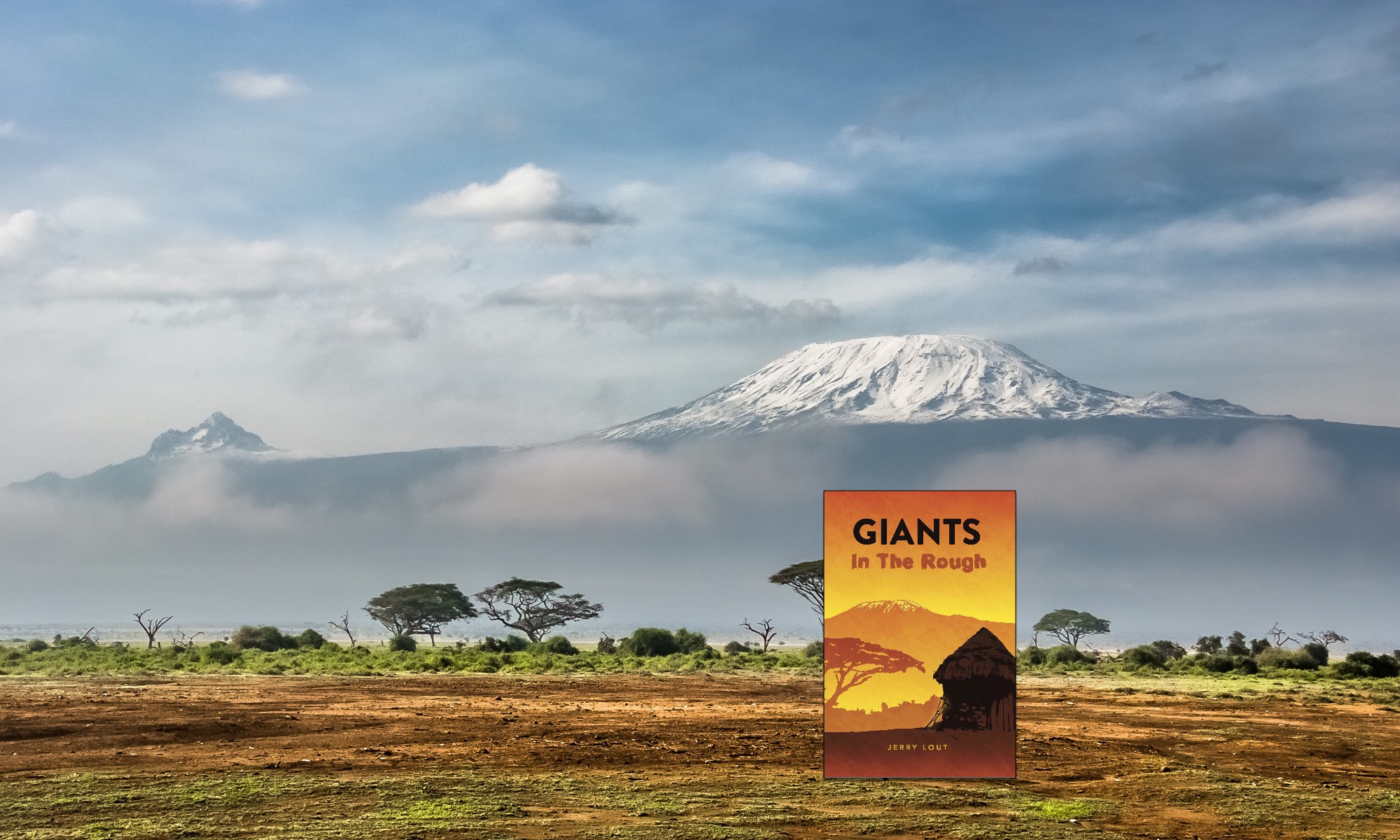
John and I were at Mashuru, a remote Maasai village, a dot on the Kenya map halfway from Nairobi to the Tanzania border. The snowy summit of Africa’s Mt. Kilimanjaro came out of hiding now and then. My first glimpse was the day before, her majestic beauty leaving me awestruck.

“Ready to hunt some wild game?”

We had finished some wiring on Eva’s small mission house and time had come for some adventure. As for the hunt’s artillery, my new friend’s 35 mm camera would do.

His VW Beetle was casting a late afternoon shadow as John eased the car to a halt at an elevated spot not far from a pool of murky brown at the edge of a wide river bed. Nice watering hole for the thirst quench of some exotic beast, I thought, recalling the region was a notable big game hunting block for all manner of wildlife. Will an elephant or a rhino show? A lion, maybe. . . leopard?

After a fruitless half-hour waiting, John touched the ignition key. “Jerry, here’s an idea.” A mix of daring and mischief flavored his voice. “These months the river stays mainly dry. Its path winds along for a few kilometers and in a little while it passes near Eva’s place”. He went on. “Let’s take the bug right up the river instead of going back along the murram road. What do ya say?” Though John had not yet spent a year in Kenya, by my standards he was the seasoned missionary veteran.

“Sure, why not.”

Before half an hour passed two things were underway. Africa’s equatorial sun was rapidly setting, spreading darkness along the riverbed and the dense forests hemming it at either side. And two young men pondered ways to free a Volkswagen Beetle sunk axle-deep in river-bottom sand. By now we had abandoned the plan to make it back to Eva’s, managing to turn the vehicle around. Still the task to escape this oversize sand-pit was daunting.

“Jerry, here’s an idea.” I had heard the phrase before.

©2017 Jerry Lout