A Greater Story

There is an interesting thing about vision. Once a person catches sight of a forward-looking hope or dream, they usually move toward it with only a tiny glimpse of additional things to follow. What they hold is a sketchy outline at best. No neatly printed, detailed contract is laid out before them – not to mention fine print!

The life-change adventure begins when we start realizing that “our vision is not our vision alone”. Indeed, when the presence of the Divine makes himself known somewhere along the way, it is then that we may start catching the wonder that his vision overlaps mine and mine converges with his. A new story is now taking shape. God’s story becoming mine as the two streams of narrative (his/mine) merge into one – much like the blending of threads forming a tapestry – eventually fused to make history, i.e. HiStory.

In not having a contract neatly incorporating fine print detail, we discover a priceless insight – usually well into our pilgrimages.  We have been spared much of what we were not ready for at any given crossroad on our long and beautiful and hard and precious trek.

Learn from the past, look to the future. . live in the present.*

Now is the favorable time**

Parting from a world of rain-starved earth and barren cotton fields (Dust Bowl territory), Clyde and Thelma lived in the present. In time “the present” became their past.  What a surprise it would have been to either of them had they discovered beforehand that they would one day come to joyous faith in a loving Savior for whom their hearts longed. And how distressing, that the life of their young son would be snatched from them by the swift waters of a Phoenix irrigation canal.

It was in the “present moment” of grief that my mother and father’s story merged with a greater story, a forever story.

©2025 Jerry Lout                               *Petra Nemcova           **2 Corinthians 6:2
Beyond Commonplace

Clutching her tan suitcase, Thelma stepped aboard the Greyhound bus. With her free hand she swept a film of dust from an empty seat. Dust. It was like a crazed intruder. “What is it like anyway”, Thelma wondered, “the Golden State?”*           

During the writing of Living With A Limp I would periodically pause and immerse myself in scenes of the imagination. The aim was to re-live as best I could a crisis here, an adventure there from true-life happenings of a bygone era. I had been granted through the years the luxury of catching bits and pieces of story as shared and then repeated in various settings by my near and distant kin. So LIMP is personal for me.

Many, if not most, works of memoir call up a collection of narratives featuring among the principal characters any number of close family members.

Thelma Christine Bay, the excited, apprehensive. westward-bound country girl, would traverse seventeen hundred miles by bus. My (future) mother had tasted her share of scarcity through most of her growing-up years. The onset of the Great Depression followed immediately by long years of drought across the Southern Plains (forming the Dust Bowl), made survival itself a burdensome day-by-day task.

My mother’s Schulter – eight miles to the south of Okmulgee – Berkeley, Phoenix, Mohave Desert, (again) Berkeley and finally Okmulgee habitations did find her at certain seasons plodding along through that mundane ordinariness common to most of earth’s pilgrims. Still, hers was clearly no insignificant life.

But then, neither is mine. Nor yours.

There is no such thing as an ordinary life**

©2025 Jerry Lout                 *Amazon. Living With A Limp            **Mark Twain

Forward Motion

The young man from Schulter glanced to his right, then left. The sun had just set and in the half-light of dusk, he knew he dare not wait. He must leap aboard the slow-moving freight train at this exact moment or not at all.

Over the coming days in varied rail yards along his westward route, a similar scene replayed. At last, his final “hijacked” train ride landed him in Oakland. Clyde was poor, having fled his native Oklahoma where an awful drought – the notorious Dust Bowl – was underway. He had to find work. The Golden State (so he was told) offered the best promise.

Weeks passed.

In a matter of days, blisters from handling construction shovels had risen on his palms. He knew that ditch digging held little promise of a future for him and his bride-to-be. But the job put dollars into Clyde’s pocket, for now, some of his first since landing in Oakland.

He worked hard and soon the ambitious Okie answered a newspaper ad, “Plumber’s Helper”.

After a short stint on the job, Clyde advanced from ‘helper’ to ‘apprentice.’

“Plumber’s Apprentice. How about that.”

Growing up in the home of Clyde Baxter Lout, I caught wind of several names. These were his fellow journeyman plumbers. Kloon. Leggett. Mason, among others.

For my dad, choosing the route of apprenticeship bore fruit.

Apprenticing to Jesus Christ bears fruit as well. Enduring and gratifying fruit. Kingdom fruit.

The apprentice-to-Jesus has shifted gears in his life’s trajectory. He sets out to grow into the kind of person he believes he’s marked by heaven to become. He embraces something called spiritual formation. Not everyone calls it this. Some speak of sanctification – an ongoing work of grace. It is characterized by living forward into a different kind of life, life on God’s terms.

At such a juncture some seekers after ‘more’, offer up a clear “Yes, I’m in. I will be a disciple of Jesus.” For others, there is a warming process, like a courtship.  Regardless, a new kind of season has gotten underway. For many who have caught the astonishingly good taste of God’s pardoning love and have drunk deeply of it through faith, they need no further persuading. They are in for a lifetime! As a widely-sung campfire melody puts it, “No turning back, no turning back.”

©2022 Jerry Lout


Commonality

The Plymouth sedan rolled to a stop in the parking lot of our little house of worship. The left door opened and a metallic glitter caught my eye as the driver began the process of exiting her car. It was a process. She swiveled slowly so both her legs, framed in stainless steel braces, dangled to the outside.

What caught my eye next was her face. Angelic? The adjective wasn’t in my word-store then but, yes. A quality beamed from the young woman’s face. Almost like a glow. Opaline’s smile overtook me. It has never left.

Falling in love with Opaline was more enchantment than romance. An unlikely combination of hardware and disposition fueled the attraction. Full limb braces on both legs combined with her smile. My meeting her at roughly age five spawned a long journey of regard. And affection. How can full-length leg braces and this kind of smile converge? My gaze dropped. I surveyed my malformed shoe fashioned so by pressure from an equally malformed foot. I smiled just as the reason for the smile caught up with the action itself. I shared a common affliction. . with an angel!

What could a flooded pasture and a paralyzing disease have in common? Perhaps nothing.

My father, Clyde Lout, was a living testament to a rural adage. Dust bowl issues succeeded in taking the boy out of the country and on to California urban centers. Nothing prevailed however at taking the country out of the boy. Oklahoma soil, long recovered from the droughts of the 1930’s, beckoned.

We moved to a small acreage outside town. Twin pear trees in the pasture – limbs heavy with their treasures most summers – supplied Tim and me with climbing and feasting pleasures. Don’t eat them when they’re green!  was our mother’s (sometimes-heeded) admonition.

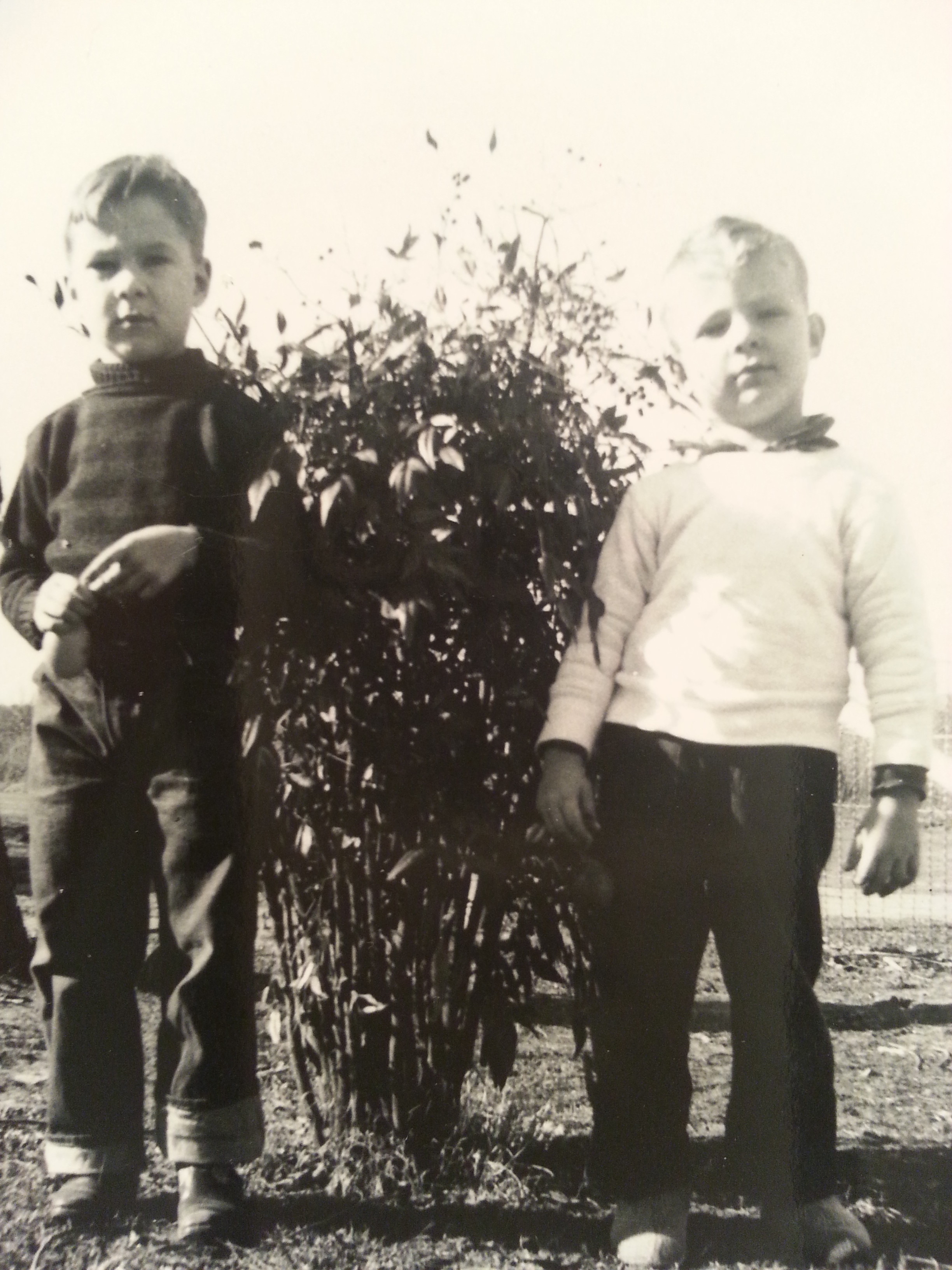
Tim and Jerry. Blog 10

Our sister Betty exercised more wisdom than her young siblings. Tim and I first learned to swim near the same pear trees in the pasture. Not in a pond or in a stream running through the pasture. We set in motion our first-ever strokes in the pasture itself.

A red-brown waterway called the Deep Fork River snaked through the countryside west of our place. During a late spring season in the mid-1950s continued rains flooded the Deep Fork. Ongoing downpours overflowed every creek and stream.

Rising waters flooded lowlands, submerging much of our five acres. Once the rain stopped my brother and I splashed about in the chest-deep mix of water and floating debris. Discovering buoyancy we propelled our way through tree bark, sticks and limbs, assorted leaves and hollowed pecan shells. And here and there – given it was the habitat of farm animals – other matter as well.

My second bout with the polio virus far exceeded the first in its severity. Whether my pastureland swim factored into the soon approaching paralysis is unresolved.

I was nine years old. My legs simply stopped working.

©2015 Jerry Lout