
Pluck

My plucky wife slipped the medical release document between unmarked leaves of her passport. Stamped Canandaigua, N.Y.,, her doctor’s letter had okayed this, her first-ever overseas flight. We would board for Africa May 26 – our first child (we didn’t know the gender) to be born in under two months.

***
“Where have you been?” The director’s voice carried an edge, the tone anything but casual.

A day earlier Ann and I had travelled the 5 ½ hours from upstate New York to Brooklyn. We would lodge at an inner-city Mission before passing through one of JFK Airport’s many international gates to then ascend into friendly blue skies.

The Mission sat in a more sullied neighborhood where pedestrian traffic sadly displayed prominent signs of addiction and vice. We probably should have known better than take our stroll around the block.

“We took a stroll around the block. . . maybe a couple blocks.”

“Please,” the Mission director’s eyes were pleading. “Never do that in these neighborhoods – day or night – not without at least one of our staff along.”

We nodded meek compliance.

Next day a gregarious volunteer-driver with a heavy gas-pedal-foot chimed, “Hey guys, on our way to the airport, let’s go via Coney Island.” I loaded luggage into the old van and helped Ann settle on to a bench seat partway back.

Street conditions citywide have trended downward somewhat since 2012, according to the Mayor’s Management Report.

So reads data filed by New York City’s Independent Budget Office. But based on a 1972 Coney Island van ride with an expectant missionary wife on board, the recent trending downward had not been the first. Of things hoped for in the nation’s biggest city, traversing Coney Island pot holes at head-clunking speed was not counted among them.

Nine years after Idlewild was renamed John Fitzgerald Kennedy International Airport we shuffled our way into the cavernous belly of America’s most-renowned passenger aircraft of the times. A behemoth of an aircraft, the Boeing 747, commonly tagged Jumbo Jet.

Our seat-belts fastened, we took each other’s hand and I voiced a prayer. The moment felt surreal. Here we were, really off to the great Africa continent. To serve – hopefully for years to come.

The leg to England was relaxed, given our adrenaline-charged hours leading to it. We would need relaxing, considering what lay ahead.

Changing airplanes in London we expected. Changing airports we did not.
©2017 Jerry Lout
Embakasi

“Jerry Lout, right?”

The accent, which I would later recognize as New Zealander, came from beyond a short railing. John Maxwell’s hand, its firm grip on a paper, pressed forward past the barrier and into Nairobi airport’s arrivals section. Labeled Immigration, it was the sector where passports, visas and such are green-lighted or rejected.

The paper being handed me was important. My Work Permit, the document required for our long-term stay in Kenya. The Permit had been signed just recently, an inky stamp-print marking approval. Good for four years. Happy to meet a welcoming presence to the continent, I took the paper from our new colleague, nodding my thanks.

Our plane had touched down minutes earlier, having traversed the Mediterranean Sea north-to-south and a long air path over the Sahara Desert.

Mile-high Embakasi Airport was just a short distance beyond the Nairobi Game Park, popular tourist attraction at the east edge of Kenya’s Capital City. The town’s name, Nairobi, was formed from a Maasai phrase meaning “cool water”. Six years would pass before Embakasi’s rechristening, paying homage to this nation’s first president, Jomo Kenyatta International Airport.

“Well, this is good!”, John’s wife announced cheerily, flashing a smile. “Seems your luggage all made it with you fine.” Jenny’s two pre-school boys bustled close by. Noting Ann’s larger-than-life midsection one asked, “Mummy, will Auntie have her baby now?”

Though wearied from travel, Ann felt lifted by the young mother’s warmth, “Let’s get you where you can relax a bit, shall we?” Jenny was Nairobi born-and-raised, and as comfortably at home in Africa as any expatriate we would come to know. From the outset our households, the Maxwells and Louts, had begun a bond.

Another person drew near – a lady graying a little around the temples, but vibrant. “Welcome, Kiddos.” The American accent stirred a good feeling somewhere inside us.

If what were needed for a pair of green missionary-hopefuls landing on the continent was a matronly, plucky veteran of Africa’s bush-country, Eva Butler fit the role. Single-mom. Servant to Kenya’s more remote peoples and cultures. Being in her company, Ann and I sensed a measure of awe. Then my mood shifted and I nearly chuckled, recalling an uncommon meeting in a small college chapel not that long ago. . . “So this is the man with the black heart!”

My wife and I smiled as, in turn, we took Eva Butler’s hand – sister to the snowy-haired, twinkly-eyed Elim President. Carlton Spencer.

In a few days I would visit one of those remote regions Eva called home. And have a taste of raw fear.

©2017 Jerry Lout

South C

Never in my life had I known a neighborhood whose name was plucked from a string of alphabet symbols.

The two cars arriving from the airport – one transporting us, the other our luggage – eased up to Maxwell’s South C home.

Their house itself sat hidden behind a stonework wall, like a shy maiden part-concealed back of a fortress of vines. And vines there were, in abundance. Bougainvillea – their rich array of petals – pinks, purples, oranges, reds garnishing much of the ‘C’ neighborhood. Ray Troyer back in San Antonio had put into my hands my first-ever 35mm camera, a second-hand Voigtlander. What beauty these flowers could show on a slide. If I can just remember Ray’s coaching how to use the thing.

“Jerry and Ann”, Jenny called out, “we’re off to Sunday morning church”. “You folks just relax. . . sleep a bit if you can. . . you’ve travelled far and long. After service we shall come collect you and we’ll go together for lunch. Good?” Weariness, having indeed caught up with us, we readily agreed. After all, this was Sunday right, a day of rest?

What would our first meal in Africa be. . . and exactly where? The question hadn’t crossed our minds. Had we given it a thought we might have assumed we would dine under a long-grass roof within a mud hut.

Entering Nairobi’s Hilton we shook our heads trying to get them around this scenario. The new and somewhat naïve American couple exited the hotel’s café an hour later having happily feasted on sandwiches and fries. ‘Chips’ Jerry, I coached myself. Fries aren’t ‘fries’ here, they’re ‘chips’.

So our first day entering Africa, a living tutorial had essentially greeted us. If formalized, an academic title might have been posted: ‘Kenya. Background and Culture 101’. This was a beautiful land of contrasts. . . rich and impoverished, tradition-steeped and cutting-edge, conflicted and united. It sobered us that we hadn’t begun to learn and it inspired us that we could start now. Here at tourism’s iconic Hilton Hotel, walking-distance from one of Africa’s largest slums – Mathare Valley.

A voice with an accent I was hearing more often called over to me. New Zealanders carried the nickname Kiwi, after the national symbol, a bird common to their Islands. “Eva needs electrical wiring put in at her Mashuru place”, offered John. “So I’ll head out there Tuesday. The job should take a couple days. . . Like to come?”

“Sure”, I piped. Getting away from the big city and out to the ‘real Africa’ would be fun, I thought. Maybe even a thrill.

Walking unarmed and alone through leopard country had not crossed my mind.

©2017 Jerry Lout

A Morning Laugh

The key slipped easily into its slot. I was downtown Nairobi, standing before a bank of metal post office boxes. The bold figures on our assigned box – shared by others of our same mission – read 30207.  Drawing out the few pieces of mail bearing the Lout name I paused at one marked with a Louisiana address. I recognized the sender though we hadn’t been in touch since I left San Antonio more than a year ago. I turned the envelope a couple times. How about this. . . What’s Ray up to these days?

Ann and I had passed through our first Nairobi, Kenya months in a seeming blur, a lot of new happening. New friends, new apartment, new culture and new car. . .New baby.

Julie Ann Lout made her squalling entry to Nairobi Hospital July 13, 1972 – a bare six weeks after our Africa landing. Our most joyous moment since Ann and I exchanged our vows.

A few weeks later I engaged another kind of newA new language.

We found we were short on funds to cover both an insurance payment coming due and my Swahili School entrance fee. By now the language studies were underway. The money worries burdened me.

On the post-office-visit day I had awakened about 5 o’clock. Our little studio flat came with an oddly arranged self-contained kitchen, separate from the rest, making possible an inviting private space for alone-time. Before boiling some coffee water I slid a chair near me and knelt before it. And found myself questioning.

Laugh? I’m to laugh?

My questioning was reaction to a direct, uninvited impression that entered my mind some moments after I knelt. “Laugh. . . simply give your voice to laughing. . . laugh.”  To consult my feelings seemed pointless. I felt like doing any number of things. Return to bed. Bemoan our money shortfall. Worry.

The word ‘laugh’ persisted, like a gentle command. A few moments passed.

OK, here goes.

“hahaha”. “hahaha”. “hahaha”.

The sounds coming quietly off my tongue were flat, lifeless as a corpse, ricocheting the yellow-painted walls of my small enclosure.  I realized that no smile accompanied my attempted laugh. Alright.

I’ll smile. I willed my face to the posture. By now, though, I had begun sensing that God’s Spirit was likely behind this unorthodox exercise. That something special may await.

Several seconds of emotionless chuckling directed upward stretched into a minute or so. For the most part my eyes stayed open, as the practice didn’t seem entirely like prayer anyway.

What happened next, there in my early-morning space, surprised me. And revisited my thinking later in the day when reading the Louisiana-stamped letter. The impact was profound.

©2017 Jerry Lout

A Sound Of Drums

“Do you hear something, Hon?”

The drum-beat rhythms seemed distant and ill-defined – more like a dream than real. Indeed, for a moment I thought the sound was a dream. But it grew in strength and as we lay wide-eyed in our fully-darkened sleeping quarters, our senses were strained. Time passed slowly.

“They’re coming nearer.”

Taranganya occupied a tiny dot on the rare Kenya map that found the outpost worthy of any space at all. The village’s claim to fame included a butcher shop. Flies gathered there to hike around on suspended beef portions well before customers took their cuts home to savor them for themselves. Pressure cookers were prized items in any missionary dwelling.

Two government schools roughly book-ended the butchery, one for elementary kids, the other, high-schoolers.  Beyond these, the one evidence that Taranganya village existed was Bukuria Mission.

Bukuria. Our first upcountry home. The place an outdoor hired hand pummeled a seven-foot spitting cobra after she raised her head just yards away and shot venomous spray my direction.

Bukuria – where a tornado ripped the metal roof off our neighbor’s house to hurl it across the compound, pretzelizing it in the branches of several trees on the way out.

Bukuria was a kind of place that stirs nostalgia. Past residents recall images of smoke clouds wafting over distant Maasai plains – evidence of herdsmen purging brown grasslands before the onset of welcome March rains.

A night watchman, Nyamahanga, was a fixed security presence on the station, greeting us at our first arrival. His armor consisted of a homemade bow with a handful of arrows (razor sharp). We had heard that tribal skirmishes may flare up in the area now and then. One wouldn’t want to be caught in the cross-fire, or worse yet, become the direct target of an angry archer.

“Lord, thanks for watching over us, over this place.”

The mission station rested on the uppermost slope of a gradually-ascending hill. Its entrance-point marked the head of a sweeping curve of the narrow, unpaved road passing before it. Our new home was in a remote sector of Kenya just five miles north of Tanzania’s unpatrolled border. The massive waters of Lake Victoria glistened from her banks 40 miles to our west.

We, the newbie missionaries, had just moved more than two hundred miles to this place, having received little orientation. We had no actual history with anyone of the Kuria Tribe.

The drumming volume intensified. Chanting sounds in a local dialect unknown to us fueled our anxiety.

Had we pondered more the impact of faith since the arrival of outsiders bearing the Jesus-news three decades earlier, our jitters would have lessened.

Our night of fitful sleep finally passed and we asked the obvious question.

The midnight drum-beats and chanting voices had stirred old film images of painted warriors, pith helmets and boiling pots. But we traced our Saturday night of sleeplessness to a little band of Kuria believers. En route to a prayer meeting.

©2017 Jerry Lout


Sensibilities

Green – Naïve – Novice – Ignorant. String them together and you had my name tag.

The rambling house that my wife, myself and our bundle of Julie settled into had been built by missionaries who pioneered the work three decades ahead of our coming. The pioneers had fashioned the dwelling from local soil – rust-tinted bricks fired in a home-built kiln.

A day or two after our Bukuria arrival, a chorus of male voices took us by surprise. Not a musical chorus but a mix of busy voices growing loud, fading back, then loud again.

Are they angry. . . enthused. . . something other. . .which? Their language was neither English nor Swahili. Kikuria, no doubt. Unsure of their disposition and ignorant of who they were, I touched the screen door. And moved to the open veranda where the dozen or so African men had assembled.

I was twenty-seven, my wife twenty-three. It was clear most of the men out-seasoned me – their skin weathered from years beneath an equatorial sun.

The group of strangers – all male – coming unannounced, still left me uneasy.

Do we invite them in? If so, what do we do next?

Are these gents all friendly to the Mission. . . We have a six-month-old girl.

Whatever else Ann and I knew, one thing was certain. We were out of our element. These were waters we’d never swum.

One of the older men – their spokesman? – moved closer. His English was broken, his accent challenging but I could make it out easily enough.

“We come to greet. We come to welcome you here to this place.”

I drew near.

“Hello”, nodding. “Hello”, smiling. “Hello”, I greeted, shaking each extended hand one by one. Though I felt more at ease and was touched by their welcoming us to Kuria-land, I was still conflicted how to respond. Only to offer repeatedly. “Thank you, Thank you, sir. Thank you . .”

I searched awkwardly for some cultural bridge to temper the situation. Answers eluded me. The visitors glanced toward one another, voiced some quiet, mysterious words. And eventually, slowly, went their way.

It was months before I learned I had made a marked impression that awkward day. By then word had got around. It took a while to redeem our name. . . “They did not even welcome us in for tea.”

The new resident-missionary – come to live and serve among the Wakuria people – successfully offended a welcoming delegation of church elders.

Like the snaking road leading past the Mission, another bend in the way lay clearly ahead – our Taranganya learning curve.

©2017 Jerry Lout


A Kuria Welcome

Most people the world over forgive offenses made by newcomers – especially when the error is done in ignorance.

We found the statement true, at least among the Kuria. Our failure as green missionaries to extend basic “please-enter-for-a-cup-of-tea” hospitality, drew no further mention from the slighted delegation of  elders.

”Hello, I am Reverend Joseph Muhingira.”

I drew comfort being courteously received by the local Overseer.

Muhingira welcomed us to his cement-plastered, tin-roofed home where his wife, Esther greeted us warmly one evening. Entering the grounds we noted several range cows – brought in from their day of grazing – jostling, mooing in the tight corral outside, just beyond the dining room. The holding pen was a weave of rough-hewn poles fashioned from skinny felled trees. Such trees dotted the rolling terrain of the area.

Esther and their eldest daughter, Robi, served my family up our first Kuria meal – roast chicken, a local spinach-like green called Sukumawiki, a cup of broth served in a modest tin bowl. And Ugali.

Ugali – a kind of corn-meal mush, was brought to the table hot – baked firm, molded in a half-moon-shaped metal bowl. Esther deftly inverted the bowl, planting it top-down on a round serving plate. She lifted the metal bowl, leaving the spherical hill of ugali steaming before us. The ugali had no odor. We did catch the fragrance of a kerosene flame. It shone from the single lantern perched atop a seasoned chest-of-drawers at the edge of the tight dining area.

A staticky short-wave radio, powered by D-size batteries, rested on the same furniture piece. From it there rang a distinct mix of African tones – high-pitched, electric guitar-plinking blended with smooth Swahili vocalists. Passing hole-in-the-wall cafes months before along Nairobi city streets I had wondered if more than one song had found its way from a composer’s pen. By now, I had started making peace with the style’s apparent monotony.

The lantern’s glow thrust eerie shadows jittering and waltzing in irregular moves along a wall, reflecting mother and daughter motion as they tended to the servings. We ate our fill and washed the remnants down with hot chai – cooked with sugar and milk thrown in together.

“Mungu awabariki.Our first dining experience in Kuria-land had ended as pleasantly as it had begun.

Thanking our hosts with the Swahili “God bless you”, we stepped from the humble dwelling. Overseer Muhingira led us on the foot-path to our little VW. Light from the vivid Kenya moon played on Julie’s upturned eyes and across the soft blanket encircling her face, giving the blanket a magical look.

The evening had gone well – Muhingira, gracious, gentleman-like. Esther’s warm personality had fit naturally with her talent at food preparation.

I turned the engine and we followed the dirt track home to the mission. In the quiet and calm of the Africa night, it seemed we had moved to a peaceful wonderland.

Meeting our neighbor, Grace – learning her story – would challenge such a notion to the core.

©2017 Jerry Lout

Survival

“Sir. . Sir, Hello. . . Hello! Can you come sir? Hello. . .”

Waking a doctor from a drink-induced sleep called for persistence.

We had transported the machete-attack victim the five miles to the government clinic, only to learn an aged, slow-moving male nurse was the only person on duty.

“The doctor for this work”, he said, eyeing the wide blood mark streaking our patient’s back, “is away. You might find him at his house.”

Leaving our patient, I drove another five miles of bad road, where I came to the darkened home of the physician. “Hello. . .Hello. . .”

Thirty minutes later, the groggy doc held a kerosene lantern (electricity had not reached the village) examining the naked wound. Thankfully, Ann’s gauze-and-sheet wrap had held and not too much blood had seeped through.

The wounded man went by Mwita. He sat upright on the cot’s edge as three pair of eyes, beside the doctor’s – Mwita’s brother’s, the male nurse’s and my own – gazed at the deep slash. I had never seen such a wound.

No surgical mask was donned by any of us. There were none in supply. And, I assumed, maybe never had been.

A brief exchange between the bush-surgeon and myself left me surprised. And troubled. The nurse had stepped to another room and was now rolling in a metal cart into view. A steel pan sat and, in it were utensils. Suturing material, I guessed.

My tone was respectful, sincere.

“Sir,” (it seemed doubtful by now the man I had wakened for the upcoming procedure was a doctor in a full, professional sense) “could I ask. . . how are the instruments sterilized?”

Lifting a sizable curved needle offered by the old nurse, the gentleman held it before the lantern for a better look. With a wave of an elbow he declared knowingly, “Oh, you understand, off there in the big cities where many people live, there are, many more germs. Many more.

“But out here in the rural places, we have fewer people. And so – less problems with infection”. The man’s silence as he squinted one-eyed, finding the needle’s opening and beginning the thread, suggested my question had been sensibly answered. This is the way it is. No discussion.

I cringed at my next discovery.

“He will be given anesthetic, right?”, I ventured.

“No, we are out of it.”

Perhaps – looking back – my biggest surprise of the evening was my lack of queasiness.

Witnessing a needle in the firm grip of someone, the needle piercing the muscular surface, tugging a string of black thread in its trail – again and again – left me at the edge of nausea.

Next morning I readied myself to visit the clinic when word of the wounded man reached me via Africa’s reliable grapevine.

“You’re sure?”, I asked a second time.

“Yes, Bwana, he walked home this morning.”

My thoughts retraced the sequence.

Treks to our place last night (who knows what distance?) – losing blood the whole way. Endures several  bumpy miles of ‘ambulance ride’. Without meds to blunt the pain, the flesh of his back takes into itself a suturing needle of questionable hygiene time and again, drawing the parted muscle and sinew close. . .

I’m now feeling queasy.

And, early the following morning, walks home – more than five miles – unaided.  

While missionaries are probably not widely known for referencing Charles Darwin, I found myself at different times suddenly recalling a phrase, “survival of the fittest”.

This was such a time.

© 2017 Jerry Lout

TEE Time

“Now, Jerry”, My friend’s voice hinted at mischief as we started across the church parking lot, “tell me about tee-hee-hee.

To know Van Gill was to treasure the sound of a rolling chuckle. And take in a pair of grinning eyes, coaxing response to his merriment.

Everything about the Texan pastor was large. Large frame, large mind (among the keenest), large humor. All of these reflecting a thing largest of all – his overflowing, over-spacious heart.

Van was a man of the Book. Indeed, it was his love of Scripture that, in part at least, stirred him to offer the teasing invitation. . . tee-hee-hee.

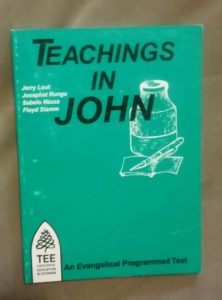
By the time of this our family’s visit from Africa, I was co-authoring a study book on the Gospel of John, a curriculum piece for Theological Education by Extension, widely labeled T – E – E.

Writer’s workshops, led by Fred and Grace Holland of the Association of Evangelicals of Africa and Madagascar, trained missionaries and nationals in Bible school text development.

After my training I had partnered with Evangelist Josephat Rungu of Western Kenya. Together, we teamed with South Africa counterparts and, Teachings in John was born. Published in Nairobi, the T.E.E. training series – featuring topics from Old Testament Survey to Bringing People to Jesus – spanned denominations and cultures across the continent.

From Latin America to Africa and beyond, T.E.E. had begun empowering the church, equipping spiritual shepherds in the care of their flocks. Especially the many pastors and elders who were unsuited, for various reasons, to traditional schooling in far-away, culturally-detached settings.

When our extension Bible school met weekly under a big tree at mid-day, we engaged a means to dodge the harsh rays. “That’s it, bring your chair again this direction, keep moving ahead of the sun.”

Week after week, month after month, young and old apprentices to Jesus engaged each other in such settings, some indoors, some out. They would sip hot tea, an open hand would fervently wave to emphasize a point. Laughter erupted now and then. The minds of these servants of God were those waking more and more to fresh discovery of truth. They grappled with ancient scripture and sought ways to apply it well. In their own lives, their households, and to the broader community of faith. Transformed lives by Jesus and the Holy Spirit, their aim.

Through our beloved Africa years, perhaps nothing – apart from watching my three children grow – brought me greater pleasure, more sheer joy.

Tee-hee-hee. Not bad.

©2017 Jerry Lout

Mr. Buckley and Baby Scott

“And, Mommy, that’s Bohkeh and her sister, Rozi. There’s my friend Mwita with his uncle Chacha. . .HI Mwita, Hi Mzee Chacha!” Julie was leaning out the car window, waving.

It seemed our three-year-old social butterfly knew every name in the tribe. Was more than eager alerting them to her presence.

“Honey, we should get ready to leave for Nairobi. I’ve confirmed our room is still reserved at the Mennonite.” Ever the attentive planner, Ann was ready to get to the capital. Baby number two would be soon on its way and we needed a buffer period in the city to spare us a potentially hasty, six-hour delivery drive.

Of the city’s handful of guest houses, the Mennonite had become our favorite. We rolled up in our dingy-white Bug. The matron – Mrs. Hostetter, donning her small, white, circular head-piece – welcomed us. After a brief exchange, she excused herself with a smile, “Dinner is at 6:00.  Enjoy your stay.”

***

“Jerry, we’d better get going.” Ann’s voice betrayed a familiar tone of two years earlier, signaling me to grab her small, shiny-red suitcase.

“OK, babe. Here we go!”

Late in the evening a nurse moved to my wife’s bedside.

“Mr. Buckley will be by to see you and your fine little boy, Mrs. Lout.”

This was a practice we still puzzle over. That it is only a fully-certified specialist who has his professional title elevated from ‘Doctor Buckley’ up to ‘Mr Buckley’. We were learning the British world of medicine, its language and meaning.

 Mr. Buckley’s visits to Ann’s bedside were always gracious, informative, professional. In short, “spot on”.

In the Africa of the 1970’s and 80’s, post-delivery care for new mothers meant extended stays of bedrest. Several days after Scott Timothy came screaming from the womb, he and his mom left Nairobi Hospital. By then every nurse and several of the new moms had drawn him close.

We checked out and the four of us made the long drive back to our remote Kenya home. Only to return to Nairobi in three months, to the same hospital.

Ann must go under the surgeon’s knife. It was crucial.

©2017 Jerry Lout